
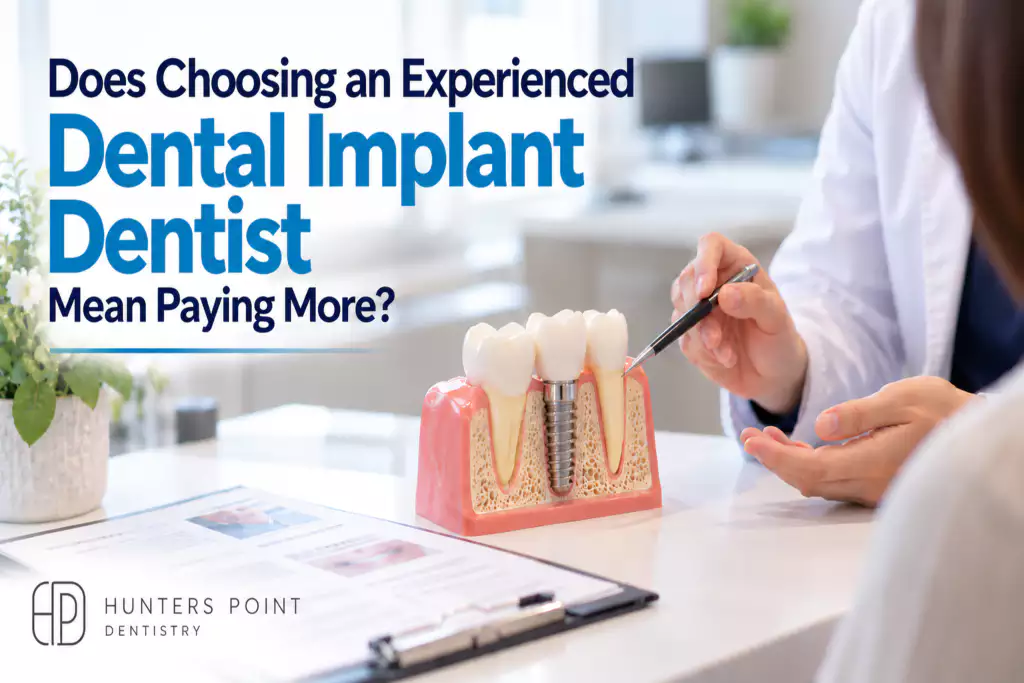
Dental Implant Dentist: Experience and Value in Long Island City
Choosing a dental implant dentist is one of the most important decisions you can make when replacing a missing tooth. In Long Island City, patients may encounter dramatically different treatment quotes, attractive advertisements, and promises of quick results. Yet an implant is not simply a product purchased at the lowest available price. It is a carefully planned medical and restorative procedure that must account for bone, gums, bite forces, appearance, healing, and long-term maintenance. At Hunters Point Dentistry, Dr. Cho encourages patients to understand what they are paying for and which questions matter before committing to treatment.
A well-designed implant can restore chewing function and help support a natural-looking smile. However, even a high-quality implant component cannot compensate for inadequate diagnosis, unsuitable positioning, or a poorly designed crown. The clinician’s judgment, the restorative plan, and the patient’s health all contribute to the outcome. This guide explains how to evaluate qualifications, compare estimates fairly, recognize potential risks, and make a decision based on lasting value rather than advertising alone.
Why Your Dental Implant Dentist’s Experience Matters
Implant dentistry requires more than the ability to place a titanium fixture in the jaw. A dentist must evaluate the available bone, identify nearby anatomical structures, assess periodontal health, and determine where the final tooth should emerge. The ideal location for a fixture is not always the easiest place to drill. Proper planning starts with the final restoration and works backward toward implant position.
Clinical experience becomes particularly important when the jawbone is narrow, gum tissue is thin, a tooth has been missing for years, or a previous infection has affected the site. An experienced implant clinician looks beyond the immediate surgical procedure and considers how the restoration will function and look years later. At Hunters Point Dentistry, complex findings can also be evaluated through collaboration with experienced dental specialists, allowing patients to receive coordinated care when advanced treatment is appropriate.
Ask who will diagnose the case, who will place the implant, who will design and deliver the crown, and who will manage follow-up. Sometimes different clinicians perform different steps. What matters is that their responsibilities are clear and that the treatment plan is coordinated.
How a Dental Implant Dentist Plans for Precision
A responsible evaluation begins with a medical and dental history, examination of the teeth and gums, and appropriate imaging. Depending on the case, three-dimensional cone-beam computed tomography, often called CBCT, may help assess bone dimensions and the relationship to nerves, sinuses, and neighboring roots. Not every patient needs the same imaging or surgical approach; the decision should be based on clinical need.
At Hunters Point Dentistry, the office website describes digital radiography and 3D CT technology as part of its diagnostic resources. Dr. Cho uses patient-specific findings to discuss whether implant treatment is appropriate and which preparatory procedures may be needed. Technology supports clinical judgment; it does not replace it.
The dentist also considers the intended crown shape, spacing, contact with adjacent teeth, hygiene access, and the direction of chewing forces. An implant positioned without sufficient attention to the future crown may be difficult to restore or clean. Thoughtful planning can help reduce avoidable problems, although no treatment is risk-free.
Why the Cheapest Dental Implant Dentist May Cost More Later
Affordable care is a legitimate priority. A higher quote does not automatically mean higher quality, and a lower quote does not automatically mean poor treatment. The problem arises when patients compare prices without understanding what is included. An advertisement may refer only to the surgical implant fixture, while the final bill may also involve imaging, an abutment, a crown, extraction, grafting, provisional restoration, and follow-up visits.
Consider two hypothetical quotes. One lists only the implant placement fee. Another includes the examination, planning, surgery, final abutment, restoration, and scheduled follow-up. The second appears more expensive at first glance, but the estimates cannot be compared until the same services are included. Neither quote proves quality by itself.
If an implant fails or the restoration needs revision, additional visits, procedures, time away from work, and possible grafting can make the overall experience more costly. Not every complication is caused by poor care; biology, smoking, uncontrolled disease, oral hygiene, and other factors also matter. Still, choosing solely by the advertised starting price can hide the full financial and clinical picture.
At Hunters Point Dentistry, patients can request a case-specific discussion of treatment phases and costs. Dr. Cho believes that understanding the scope of treatment is more useful than relying on a one-line price comparison.
Does an Experienced Dental Implant Dentist Have to Cost More?
Not at all. Experience and quality do not have to mean an inflated price. At Hunters Point Dentistry, we believe patients deserve thoughtful implant care at fair, reasonable, and competitive prices. The aim is to combine careful planning, modern technology, and clinical expertise with transparent discussions about costs—not to recommend more treatment than a patient needs.
Dr. Cho evaluates each patient’s bone support, gum health, bite, restorative goals, and budget before discussing appropriate options. A clear estimate should explain which services are included and whether additional procedures might be necessary. This approach helps patients compare the complete scope of care instead of focusing on a single advertised figure.
For especially complex implant cases, Hunters Point Dentistry also collaborates with experienced dental specialists when additional expertise is needed. Our priority is to help patients make informed decisions while pursuing both quality and affordability. Patients should feel comfortable asking questions about treatment choices, timelines, and costs before moving forward.
Questions to Ask a Dental Implant Dentist Before Treatment
Begin with qualifications and case assessment. Ask what implant-focused education the clinician has completed, how similar cases are approached, and whether your situation calls for referral or collaboration. Ask to see the proposed treatment sequence and understand what findings support the recommendation. A trustworthy discussion should include both benefits and meaningful risks.
Ask whether your gums are healthy enough for treatment, whether there is adequate bone, and whether extraction or bone grafting may be necessary. If the tooth is visible when you smile, discuss gum contours and how the temporary and final restorations will look. If you grind your teeth, ask how bite forces will be managed.
Finally, request a written estimate identifying the implant fixture, abutment, crown, imaging, grafting if indicated, and follow-up arrangements. Ask what happens if healing takes longer than expected or an additional procedure becomes necessary. Clear answers are a better signal than a promise of a perfect result.
What Makes a Qualified Dental Implant Dentist Different?
Credentials should be verified and understood in context. A dental degree establishes foundational professional education; continuing education, relevant experience, professional memberships, and focused implant training provide additional information. Patients should also consider communication, treatment planning, and the dentist’s willingness to explain alternatives.
Dr. Cho earned her DMD from Harvard School of Dental Medicine and brings more than ten years of dental experience to patient care. She also holds fellowship status with the International Congress of Oral Implantologists (FICOI), reflecting her commitment to continuing education in implant dentistry. At Hunters Point Dentistry, patients benefit from thoughtful clinical assessment, modern diagnostic resources, and a treatment plan designed around their individual oral health and restorative goals.
For patients with more advanced needs, Hunters Point Dentistry also works with highly experienced dental specialists. Cases involving significant bone loss, complex anatomy, multiple missing teeth, or extensive reconstruction may benefit from additional expertise and coordinated treatment planning. Dr. Cho and the clinical team can discuss which approach best fits the case, with attention to both surgical requirements and the final restorative result.
Specialist Support for Complex Implant Cases
Not every implant case is straightforward. Patients who have worn dentures for years, lost several teeth, experienced advanced periodontal disease, or require rebuilding of the bite may need a more comprehensive plan. Treatment may involve staged extractions, bone augmentation, soft-tissue management, or coordination between surgical and restorative providers. At Hunters Point Dentistry, Dr. Cho can help patients understand these considerations and coordinate with experienced dental specialists when a case requires advanced expertise. This team-based approach keeps the focus on the full treatment journey rather than any single procedure.
A thoughtful plan also accounts for the final appearance and feel of the teeth. For front teeth, the contour of the gums and the emergence of the crown can be as important as the implant position. For back teeth, bite forces and hygiene access deserve close attention. Patients deserve a clear explanation of the proposed sequence, realistic healing intervals, and what is included in the restorative phase.
How a Dental Implant Dentist Evaluates Long-Term Success
An implant is intended to function as part of an entire oral system, not as an isolated screw. Long-term health depends on stable supporting bone, healthy tissues, a restoration that can be cleaned, appropriate bite forces, and regular professional monitoring. Peri-implant inflammation can develop even around a previously successful implant.
The dentist should review the health of neighboring teeth and any history of gum disease. In some situations, controlling periodontal inflammation or adjusting an existing bite problem is advisable before implant placement. Patients with certain medical conditions or medications may need additional evaluation or coordination with their physicians.
After restoration, daily brushing, cleaning around the implant, and periodic examinations remain important. Implant crowns cannot develop cavities, but surrounding gums and bone can still become diseased. The ability to maintain the implant comfortably over time deserves as much attention as its appearance on the day the crown is delivered.
Advice on Healing and Risk
Healing varies considerably. Some patients can receive an implant at the time of extraction, while others benefit from a staged approach after infection management or bone augmentation. Immediate placement does not always mean an immediate permanent tooth, and a temporary restoration may have special chewing restrictions.
Possible complications include infection, failure of the implant to integrate with bone, injury to adjacent structures, gum recession, prosthetic screw loosening, and chipping or fracture of restorative materials. Some risks are uncommon but important. A careful consultation should explain the risks that are relevant to your anatomy and health rather than present one universal success percentage.
Contact the treating office promptly if you experience increasing swelling, persistent bleeding, fever, severe or worsening pain, or a loose component. Follow individualized post-operative instructions. At Hunters Point Dentistry, Dr. Cho can explain the expected timeline and the signs that should prompt an assessment.
Comparing a Dental Implant Dentist With Other Tooth-Replacement Options
An implant is not the only reasonable way to replace a missing tooth. A conventional bridge may be appropriate when neighboring teeth already need crowns, and a removable partial denture may offer a less invasive alternative for some patients. In selected circumstances, monitoring a space or choosing not to replace a tooth may also be discussed.
Implants generally avoid using adjacent teeth as bridge supports, but they require adequate anatomy, surgical treatment, healing time, and ongoing maintenance. A bridge can sometimes be completed more quickly, yet it involves different compromises. There is no single best answer for every mouth or budget.
When comparing an implant with a bridge or removable appliance, the key question is not simply which option is fastest. The decision should account for the condition of adjacent teeth, bone support, bite forces, appearance, maintenance, and the patient’s long-term priorities. An individualized consultation helps clarify which solution is most appropriate.
Why LIC Patients Choose Hunters Point Dentistry
Convenience matters when treatment involves a consultation, surgery, restoration, and maintenance visits. Hunters Point Dentistry is located at 10-27 Jackson Avenue in Long Island City, near the Vernon Boulevard–Jackson Avenue subway station. The location can make follow-up more manageable for residents and professionals with demanding schedules.
But convenience should complement, not replace, clinical confidence. Dr. Cho emphasizes communication and patient-specific planning, and the practice describes its digital diagnostic resources and restorative services online. Patients can bring previous radiographs, a written estimate from another practice, or questions about an existing implant recommendation to discuss during a consultation.
At Hunters Point Dentistry, the goal is to make the entire process understandable, from the first evaluation to the final restoration and routine maintenance. Dr. Cho emphasizes a clear explanation of the treatment sequence, the purpose of each recommended step, and how to protect the investment in your smile over time.
FAQs for LIC Patients
Is the most expensive implant dentist always the best? No. Price alone does not establish skill, safety, or suitability. Compare qualifications, the actual plan, the included services, and how complications and follow-up are handled.
Do I always need a bone graft? No. Grafting depends on the quantity and quality of bone, the desired implant position, and other individual findings. Your dentist should explain why it is or is not recommended.
Can an implant be completed in one day? Some patients qualify for immediate placement or a temporary restoration, but definitive healing and the final restoration often require additional time. Same-day advertising may describe different treatment stages.
Does insurance cover dental implants? Coverage depends on the policy, exclusions, annual maximums, and individual benefits. Request a written estimate and confirm benefits rather than assuming coverage.
How do I prepare for a consultation? Bring your medication list, relevant medical history, recent dental images if available, and any competing estimates. Write down your priorities concerning function, appearance, timing, and budget.
Choose a Implant Dentist for Lasting Value
Choosing a dental implant dentist is about more than finding an attractive advertised price. Strong diagnostic judgment, advanced training, careful restorative planning, and access to experienced specialists for challenging cases can make a meaningful difference in the overall treatment experience. Hunters Point Dentistry welcomes patients from LIC, Hunters Point, Court Square, Queensboro Plaza, Gantry Plaza, Dutch Kills, Ravenswood, Blissville, and Queensbridge who want to explore implant treatment with a team focused on quality and personalized care.
If you are considering an implant or want a second opinion about a treatment estimate, call Hunters Point Dentistry at 347-507-5759 or schedule an appointment online at https://hunterspointdentistry.com/contact/. Dr. Cho and the team can review your needs, explain appropriate options, and help you make an informed choice.